Garrett described it like this: "It goes clunk over bumps in the front, and squeals in the back when I stop. Sometimes both." He was very calm about it. I've learned that when a sixteen-year-old mentions two noises in one sentence, the car has been making them for at least two weeks.
The Civic had just passed 149,800 miles. I rode along on a drive around the north end of town. The clunk was easy to find, a dull knock from the front on every little dip, louder on the right. The noise from the back wasn't quite a squeal, more of a scrape at low speed when he braked. Both were real.
With the car parked, I had Garrett rock it side to side while I listened at each front wheel. The knock came from the sway bar links, the short rods with a ball joint on each end that connect the sway bar to the struts. When I grabbed the right one and pushed it, I could feel it move. A good link doesn't move at all. Worn links are a common clunk on a car this age, and they're one of the cheaper fixes you can get.
The struts were new in April, so I was glad it wasn't those.
The back brakes, which we did ourselves
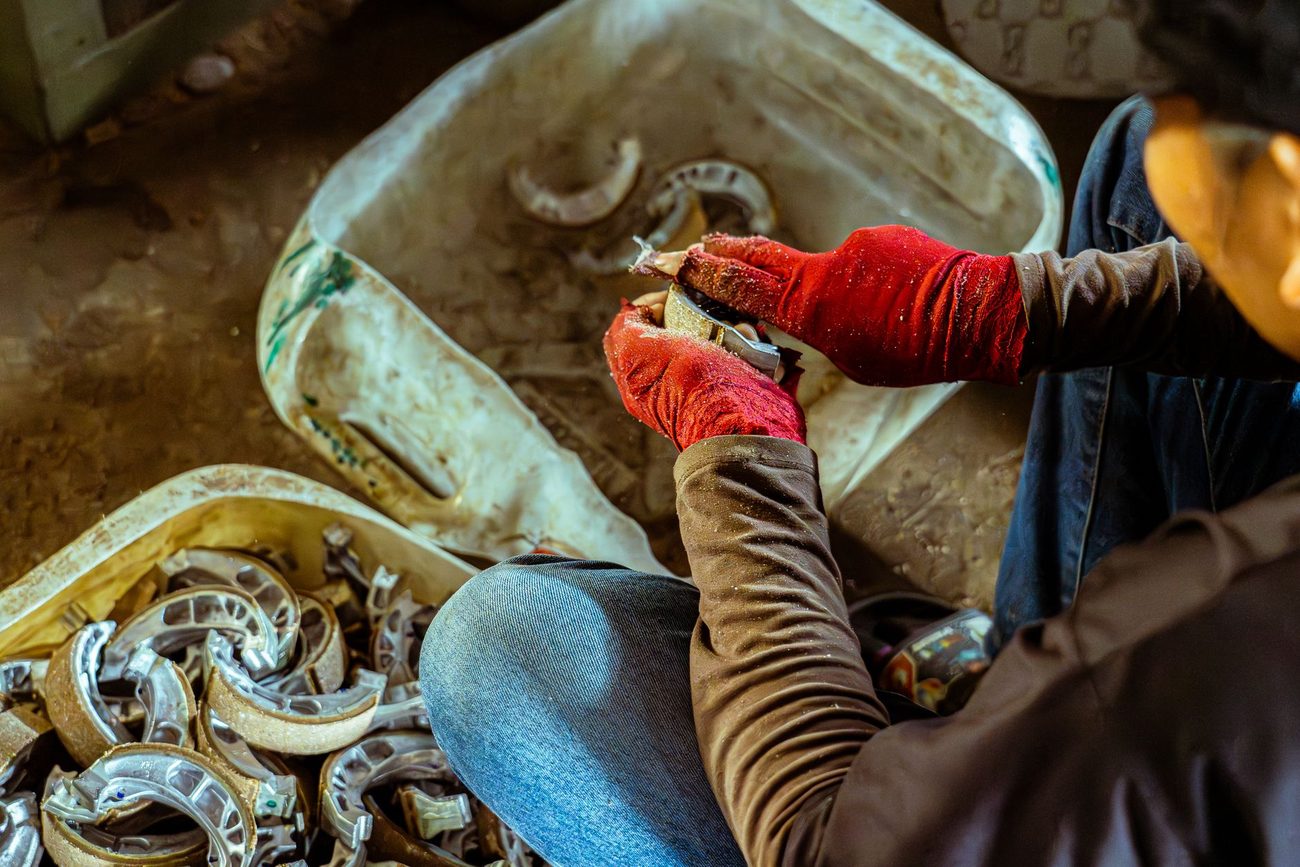
A 2012 Civic LX has drum brakes in the back, not discs. Inside each drum there are two curved shoes that push outward against the drum to stop the wheel. When I pulled the right rear drum off, the shoes were worn thin and the drum had a groove worn into it. That scrape was the shoe's metal edge starting to touch.
So we did the rear brakes in the garage on Wednesday evening, with the Civic inside under the two LED shop lights I put up last summer. Garrett did most of the wrenching. I did most of the pointing. Here's what it took:
- Rear brake shoes: $42
- Two new rear drums: $92
- Drum brake hardware kit (springs and clips): $24
- Brake cleaner and brake grease: $12
That's $170 in parts. Drum brakes are fussier than discs because of the springs, so we did one side at a time and kept the other side together as a picture of how everything goes back. We took a photo of each side before taking it apart, too. Car on jack stands, wheels chocked in front, never just the jack. And don't blow the brake dust out with compressed air. Spray it with brake cleaner and wipe it down.
It took us about three and a half hours for both sides, including a twenty-minute argument with a spring that kept jumping off. Garrett won it. I wish I'd recorded his face when it finally clicked into place.
The links, which the shop did
I planned to do the sway bar links too. They're held on by two nuts each, and on paper it's a thirty-minute job. On this car, after twelve Missouri winters of road salt, the nut on the right link was rusted on solid, and when I put a wrench on it, the stud inside the link just spun. The usual fix is to hold the stud with a second wrench, but the rust had eaten those flats, too. The real answer at that point is heat or a cutting wheel, and I don't own a torch or feel good about using one near rubber boots and a fuel line. So I put the wheel back on and called our shop.
They did both front links on Thursday, September 3. The bill was $277: $78 for the pair of links, 1.4 hours of labor at $132 ($184.80), $8 in shop supplies and about $6 in tax. The labor ran a little long because of the seized nut, which they showed me. It had to be cut off.
How we split it
The two jobs together came to $447: $170 in brake parts and $277 at the shop.
Our rule since he got the car has been that safety repairs and normal wear come out of the family budget, and Garrett pays for anything his own driving caused. Brakes and links are wear. But Garrett has a paycheck from the grocery store now, he just finished paying off his half of the July bumper scrape, and he asked if he could pay for the brake parts himself. I said yes. So the split was $170 from Garrett and $277 from us.
He drove the car to school the next morning. No clunk, no scrape. He texted from the parking lot, which is a house rule, and then added a second text: "Brakes feel good." I read it twice.